
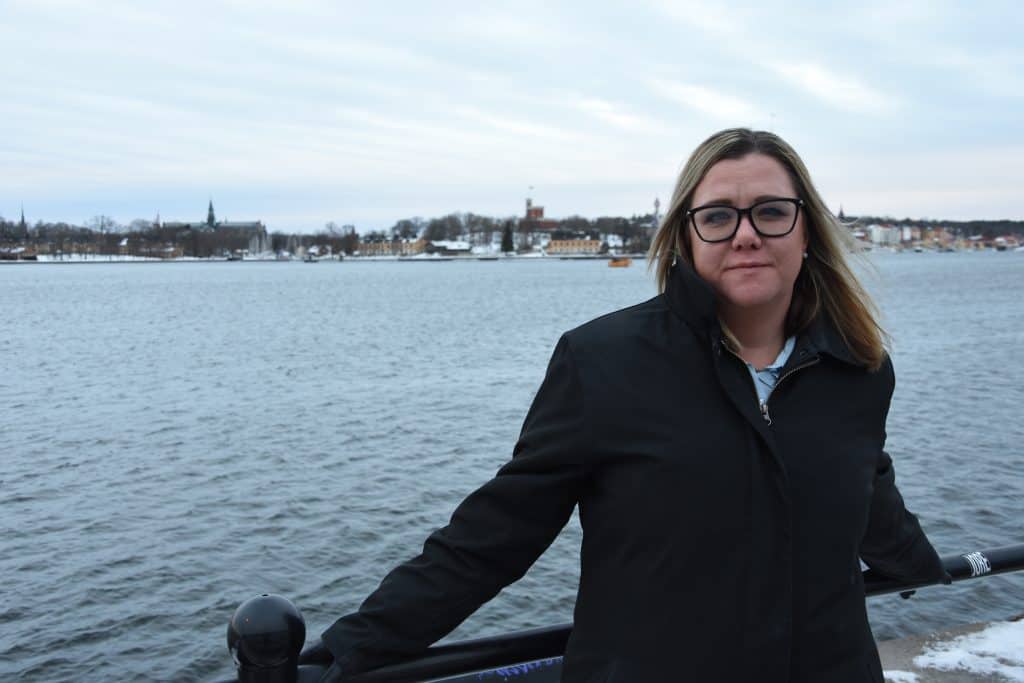
When Malin talks about her family in Helsingborg, her home town, her career choice is easy to understand. With a father, sister, brother, uncle, cousin and brother-in-law all working or having worked in shipping, seafaring was always close at hand.
“For a while, we were almost all on the same ship – and it worked out very well,” she says. “Though I feel a little sorry for my mother sometimes when we meet because we all tend to talk shop.”
While almost everyone else in the family works as a crewmember or engineer officer, Malin chose to work in the service department. She started with hotel service on one of the TT-Line passenger ferries and has worked her way through a number of different posts. When she went ashore in the spring of 2022 to start work as an ombudsman in the Swedish Maritime Officers’ Association, she was purser on the M/S Aurora, a Foresea ship (now Öresundslinjen). Her years on board have given her a good understanding of officer positions and she knows which issues she wants to prioritize in her current job, including managers’ work environment.
I enjoyed life more on ships, but I also benefit a lot from being able to write
 I enjoyed life more on ships, but I also benefit a lot from being able to write
“As purser, you often work on your own and you can tie yourself in knots trying to fix everything for the crew, but you forget that you have your own work environment too. I think that is quite common among officers, regardless of their department,” says Malin Persson.
She finds the psychosocial work environment and issues related to social and organizational issues particularly interesting.
“In the last 20 years there have been quite few changes, such as people talking to each other in a completely different way. In the past there was very little that would make you raise your eyebrows, but now you almost choke on your coffee when people say the wrong things. It’s probably the case in society as a whole though, not just in shipping.”
She also thinks the physical work environment on board has improved.
“Of course, it varies depending on where you are working, but the last ships I have worked on had a great physical work environment and you had everything you needed on board.”
What does give her cause for concern, however, is the fast pace of work.
“As head of a department on board, you have one manager on the ship, but then there are maybe three or four managers in different departments ashore who also want things done. Mental fatigue and burnout are not unknown among warrant officers.”
Malin Persson has spent most of her professional life on board, but there was a time when she wanted to try something different. She had always enjoyed writing, so she went on a three-year course to become a journalist at Linnaeus University in Kalmar. After just one summer as a reporter for a Helsingborg newspaper, though, she went back to sea.
“I enjoyed life more on ships, but I also benefit a lot from being able to write. An ombudsman does a lot of writing and we compare texts with each other,” she says.
Malin Persson is a board member of SAN and works for Vågrätt, an organization which promotes gender equality in shipping. She is also a member of a review group at the Swedish Mercantile Marine Foundation, which decides which projects the Foundation will give awards to.
“I find health and safety issues interesting and I want to be involved and make a difference, so if there is a place for me in such areas, I am happy to take it.”