
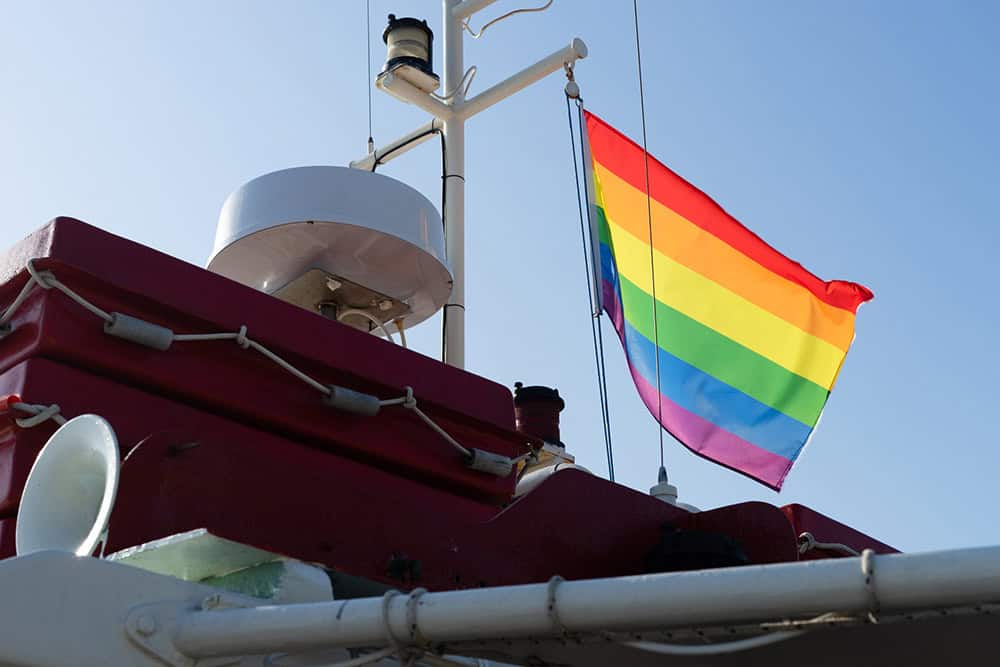
Not daring to be open about who you are at work can be especially challenging for those working onboard, where both work and leisure time are spent on the ship. Photo: Istock
It is not uncommon for LGBTQI people (lesbian, gay, bisexual, transgender, queer and intersex) to be discriminated at work. This may include discriminatory jokes, crude banter, harassment or even death threats. The Swedish Agency for Work Environment Expertise, Mynak, was commissioned by the government to publish a compilation of information about LGBTQI people at work. The report was published in 2022 and includes about 300 research investigations into the work environment of LGBTQI people. The results show that even though many LGBTQI people feel they have a good work environment and are happy with their colleagues, discrimination linked to sexual orientation or gender identity is also common. Andrea Eriksson, professor of ergonomics specialising in the psychosocial work environment at the Royal Institute of Technology in Stockholm, produced the compilation along with Sara Andersson, PhD at University West, and two other researchers.
“We see a fairly wide range of different problems faced by LGBTQI people. They include discriminatory jokes, banter and harassment, and conscious as well as subconscious actions. But the most common issues are what we call microaggressions,” says Andrea Eriksson.
Microaggressions are described in the report as “… subtle and sometimes subconscious aggressive actions in the form of comments, jokes, questions and so on”. It can sometimes be difficult for a person exposed to microaggression to know whether it should be interpreted as a deliberate slur or not.
“It could be a comment which is not a clear insult or related to gender or sexual orientation. This kind of subtle attack can be difficult to deal with. If the person protests, the response is often something like, “It was just a joke, take it easy.” Sometimes the victim feels forced to accept it to avoid being excluded from the working group,” says Sara Andersson, and continues.
We see a fairly wide range of different problems faced by LGBTQI people.
 We see a fairly wide range of different problems faced by LGBTQI people.
“Many people have had good outcomes when they speak up, though, and the other person has apologized.”
According to the researchers, many of the problems that LGBTQI people face in their workplaces are a result of the heterosexual norm that is so often prevalent, meaning there is an assumption that everyone is heterosexual and those with a different orientation are abnormal, leading to exclusion and a feeling of alienation among people who are not part of the norm. LGBTQI people are thus made invisible and issues around that group are forgotten.
“In heteronormative workplaces, it may be difficult for LGBTQI people to be themselves and discuss their private lives. You certainly don’t have to be open about your sexual orientation, but in an inclusive workplace people who choose to should be able to be honest without risking criticism or worse,” says Sara Andersson.
LGBTQI encompasses people with many different sexual orientations, who are exposed to varying degrees of discrimination. According to the report, bisexuals are generally picked on more than homosexuals, and things are even more difficult for trans people. In one study of 105 trans people, the majority had suffered from microaggressions and some had even received death threats. Non-binary people, who do not identify as either male or female, also routinely suffer from discrimination.
“The further you are from the norm, the more you are attacked. It may well be based on some kind of fear or ignorance on the part of the offender, but much of it is linked to stereotypical perceptions of other people,” says Andrea Eriksson.
The report also shows that there are certain factors which increase the risk of harassment of LGBTQI people, such as male-coded workplaces, where predominantly men work with traditionally male tasks. For those who work on ships, the fact that you both live and work on board can make it more difficult for LGBTQI people, according to Sara Andersson.
“For those who do not wish to be open about their sexual orientation or gender identity at work, it can be an extra stress not being able to go home in the evening. It may mean that you can’t really be yourself and constantly having to think about what you say and how you behave can produce a lot of anxiety.”
The report also takes up health factors, i.e. what makes people contented at work and what could increase the sense of inclusion. Such factors include managers that are both present and trustful, participation in activities, influence, fairness and transparency.
“In workplaces that offer security and inclusion, support is usually found all the way up to upper managers, who clearly show their standpoint on these issues and make sure to train other managers and staff,” says Andrea Eriksson.
One of the single most important factors for a healthy and inclusive workplace is the employer’s responsibility and leadership. Managers’ actions have a direct impact on health, well-being and job satisfaction among employees.
“Managers are very important in this context. They are responsible for ensuring that work environment legislation and discrimination legislation are complied with. As a manager, you also have great opportunities to influence people by ensuring clarity on issues and being a good role model,” says Andrea Eriksson.