
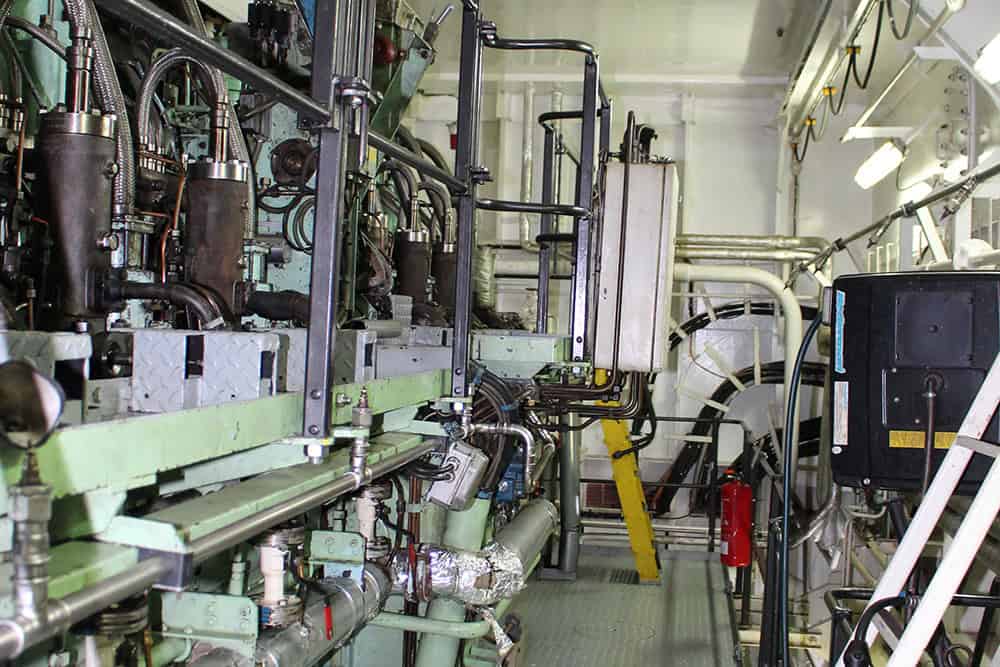
For decades, asbestos was widely used on land and at sea. Materials containing asbestos were very popular since they were heat-resistant, durable and attenuated both sound and vibrations. However, the harmful effects of asbestos fibres on health became increasingly evident, leading to a total ban on asbestos on land in 1982 and six years later a total ban on new installations with asbestos on Swedish ships. In international shipping, asbestos was not banned on newly built vessels until 2011. Although asbestos is no longer permitted, it remains a problem in shipping. According to the obligatory asbestos inventories for Swedish-flagged ships, 75 of 507 ships inspected contained asbestos as reported by the Swedish Transport Agency. Most inventories were carried out in 2013 – 2015. Asbestos is sometimes discovered on ships where, according to the inventory, there should be none. Pelle Andersson, ombudsman at Seko Seafarers, is not surprised at the result. He says that new cases related to asbestos come up every year.
“We usually have one or two cases a year regarding asbestos,” he explains, “either on older ships in the process of flagging in which already have asbestos on board, or because someone has been exposed to asbestos. Most often because people were unaware that there was asbestos on board.”
Asbestos is found mainly on older ships. According to Pelle Andersson, it is most likely to be found on ships built in the start of the 1980s or earlier. Asbestos is found in a variety of places and materials, in all sections of a ship.
“It could be sprayed asbestos inside a bulkhead that is added for for fire protection. Sometimes asbestos has the consistency of chalk and is used as insulation on pipes, but it is also found in electrical panels, flooring adhesive, joints and fixtures in bathrooms and many other places,” says Pelle Andersson.
We usually have one or two cases a year regarding asbestos.
 We usually have one or two cases a year regarding asbestos.
Asbestos may also occur on newer ships. In a report from the Netherlands presented at the IMO in 2010, asbestos was found on board 95 percent of the 300 ships inspected. In countries such as India, Russia and China, asbestos is still permitted and it may come on board with spare parts.
“Even if a manufacturer claims that a spare part does not contain asbestos, that’s no guarantee. You must always be vigilant. Don’t hesitate to ask questions and demand an asbestos test before work starts if you suspect there may be some present. Test results usually arrive within three days and only cost around 500 SEK,” says Pelle Andersson.
Gustaf Bäck is an asbestos expert at the Swedish Work Environment Authority. He says that asbestos can sometimes be difficult to detect, but underlines the fact that employers are responsible for checking asbestos on board. Any companies whose employees are exposed to asbestos risk being fined.
“As an employer, you must know where there is any asbestos so that nobody is exposed to it without protection. If you start removing asbestos without a permit, you will be fined,” says Gustaf Bäck.
The Work Environment Authority regulations on asbestos became even more stringent recently. Protective clothing and personal equipment that has come into contact with asbestos is now assumed to contain asbestos and must be handled accordingly. Anna Bizzozero is section manager at the Maritime and Aviation Department at the Swedish Transport Agency. She is aware that asbestos is still a problem in shipping, but thinks that it could easily be phased out.
“There are better, cheaper materials than asbestos that also insulate well. Hopefully, asbestos will disappear completely as older ships are scrapped and it is no longer manufactured,” she says.
Processing or removing materials containing asbestos is not permitted, although certain exceptions are made for shipping when asbestos may be handled, such as during an emergency that must be managed at sea. The Swedish Transport Agency website states that the following requirements must be met in order to obtain a permit to carry out asbestos work on board: training certificates for supervisors, training certificates for the workers, certificates of fitness for service, handling and safety instructions and a statement from a local or regional safety officer. Technical and personal protective equipment adapted for work with asbestos must also be used.
“The right equipment is often not available, so shipping companies must get better in this area to prevent their employees from being exposed to asbestos. It is also important to mark the areas on board where asbestos is known to be present, otherwise personnel are at risk,” says Pelle Andersson.
On ships, asbestos may be found in:
• Fire blankets• Gaskets
• Insulation
• Seals
• Friction linings
• Wall and ceiling panels
• Ropes
• Glue and joints in bathrooms
• Electrical fuses
Source: Swedish Transport Agency
Read more about the rules that apply to asbestos in shipping on the Swedish Transport Agency website