
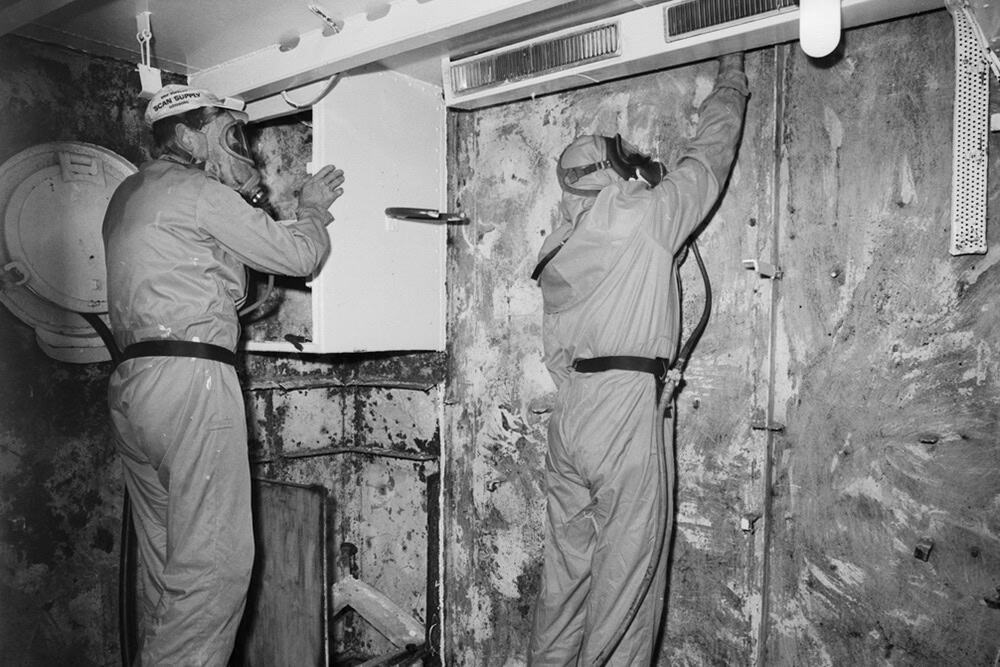
Health and safety challenges on ships are similar in many ways to workplaces ashore; there are repetitive movements, heavy lifting, stress and little time for recovery. However, the shipping industry also has several specific conditions since ships are in constant motion and crews live together in a limited space, with all the associated issues. In the first decades of the 1900s, injuries and deaths were common in shipping. In 1955, for example, there were about 400 fall injuries reported on Swedish ships, and 219 people injured by tools. Shipwrecks were also relatively common, often with a resulting loss of life. With this background, the Swedish Seafarers’ Union arranged an occupational safety conference in October 1955 at Folkets hus in Gothenburg. Representatives attended from the four maritime trade unions, the Swedish Shipowners’ Association, the Royal Board of Trade, the Occupational Safety and Health Board, as well as Maritime Magazine’s editor-in-chief Ture Rinman. According to the minutes, the participants agreed on the need to formalise cooperation to create more tolerable conditions on board and reduce the number of accidents. On 6 April 1956, the parties met again and by unanimous decision, the Maritime Central Occupational Safety and Health Committee (SCA) was formed, which became the Maritime Work Environment Committee, or SAN for short. The initiative was described as historic and news of the newly formed committee spread outside shipping circles through the newspapers’ telegram agency, TT.
Dr. Ljung claimed that the risk of accidents increased five times with higher blood alcohol levels
 Dr. Ljung claimed that the risk of accidents increased five times with higher blood alcohol levels
During the 70 years that have passed since SAN was founded, many activities have been carried out and numerous health and safety issues have been addressed. In the early 1960s, for example, drinking habits of crews was a major discussion topic in SAN. In the May meeting of 1963, the board invited Doctor Ljung, described in the minutes as “a medical expert in determining the role of alcohol in the context of accidents at Broströms Linjeagentur”. Dr. Ljung claimed that the risk of accidents increased five times with higher blood alcohol levels, which he described to the members of the SAN board. He considered that all shipping companies should introduce rules for the sale and consumption of alcohol at sea and he felt that it was wrong for officers and accountants to make money from sales of spirits on board.
The seventies were an eventful decade at SAN, with several major work environment projects carried out, including the production of safety shoes in collaboration with a shoe factory. The safety shoe was named “Pajaladojan” after the M/S Pajala, whose safety committee had initiated the development of a “worthy work shoe” for seamen. SAN also started collaborating with the Red Cross, and a joint first aid procedure was developed for accidents. The first issue of SAN News was printed in 1976, which initially consisted of one page of accident information sent to shipping companies for distribution on their ships. Over time, the publication developed into an editorial magazine of eight pages in the same format as it is now. In the 1970s, the largest work environment event for SAN was the new Occupational Health and Safety Act on Board. SAN was commissioned to develop a training course for safety officers and the board held a large number of courses, before responsibility for such training was taken over by Seko Seafarers. Olle Bråfelt was very active in SAN at this time and he founded the Insjö/Foresea incident reporting system. In an article published in SAN News no. 1 of 2016 in connection with its 60-year celebrations, he said the following about the need to create a safer work environment on board:
“We probably had around ten deaths on ships every year due to accidents, and a large number of deaths from work-related diseases following exposure to asbestos, hazardous chemicals and so on. I would wager that there was no parallel in any other industry.”
During the 1990s, cancer among seafarers became a major issue. In 1998, Ralph Nilsson, a chief physician, defended his doctoral thesis Cancer among seamen at Sahlgrenska University Hospital in Gothenburg. Among other things, his research showed how the body absorbs carcinogens through the skin and how this is aggravated by the use of oily gloves and dirty overalls of the “wrong” materials. Cancer research in shipping continued for several years, including that by the chief physician and researcher Karl Forsell.
After the millennium, work environment management in shipping entered a new phase. In 2003, the Work Environment Act also came into force on ships, and with it the requirement for structured and systematic work environment management. The Swedish Maritime Employers’ Association, Sarf, with SAN’s chairman Pieter Sprangers at the helm, organised courses in systematic work environment management for senior officers and there was a great interest in participating. The next big change came three years later when the International Labour Organization (ILO) adopted the Maritime Work Environment Convention, MLC. Many of the provisions in the MLC had already been implemented on Swedish ships, but for global shipping, the Convention was a milestone and included requirements for good cabin standards and financial support in the event of injury or illness. In the 2000s, issues regarding social and mental health in working life, such as stress, lack of recovery, bullying and sexual harassment, have been given greater space. In 2016, the Organizational and Social Work Environment regulations came into force at workplaces ashore, and three years later they also applied in shipping. In the 2010s, SAN developed an online work environment course and the handbook for work environment management on board was recently updated. The SAN Board of Directors currently consists of eight ordinary members with representatives from Seko seafarers, the Maritime Officers’ Association and Sarf. There are also a few co-opted members from the Swedish Transport Agency, researchers and the Swedish Navy.